Fighting the Tobacco Epidemic

On November 1, France launched “Moi(s) sans tabac” (“month/me without tobacco”), the very first national campaign of its kind, which will use all existing social media and digital tools to encourage smokers to quit. Inspired by the UK’s “Stoptober” campaign, which started in 2012, it sets the goal of stopping for the entire month of November, 30 days without smoking, which multiply the chances of quitting by five.

9786177825_73ed90e5fb_zUsers can sign up online to join the community and get personalized advice; call a phone number where they can talk to smoking cessation specialists; or download an application that can track their progress, cheer them on, and calculate their savings. On November 1, over 130,000 smokers had signed up.

It is estimated that tobacco is as addictive as heroin, with approximately 60% of those who try it becoming addicted. Of regular smokers, experts calculate that about half will die of smoke-related consequences. In France, there are around 73,000 smoke-related deaths each year. In 2003, a government report found that France’s male population had the highest level of cancer-related deaths, more than any country in the European Union, caused directly by cigarette use.

How did this tobacco epidemic begin? What are some environmental factors that play into tobacco addiction? What are some intervention that have been effective in helping smokers quit?

Read more about tobacco and health here:

Photo credit.

In Conversation with Barry M. Staw, of Berkeley-Haas

Barry M. Staw, Professor Emeritus at the Haas School of Business at the University of California, Berkeley, talks to Frederick P. Morgeson, Professor at the Eli Broad College of Management at Michigan State University and Editor of the Annual Review of Organizational Psychology and Organizational Behavior.

In this conversation, Dr. Staw discusses the inspiration behind his work on escalation of commitment, a construct he formulated based in part on his family history and, later, studying the nature of the U.S.’ engagement in the Vietnam war. He also gives advice to younger researchers, from where to find inspiration for research and staying grounded in reality to preserving a unique voice in research articles.

Watch the video series here.

Bernard L. Feringa, Laureate of the 2016 Nobel Prize in Chemistry

pc600407-f9Congratulations to Bernard “Ben” L. Feringa, of the University of Groningen in The Netherlands, who shared the 2016 Nobel Prize in Chemistry with Jean-Pierre Sauvage, of the University of Strasbourg in France, and Sir J. Fraser Stoddart, of Northwestern University in the U.S. They were rewarded “for the design and synthesis of molecular machines.”
Dr. Sauvage was the first, in 1983, to create a catenane, a chain of mechanically interlocked molecular rings. Eight years later,  Dr. Stoddart built upon this by creating a rotaxane, a molecular ring threaded through a molecular axle.

Using these techniques, in 1999, Dr. Feringa was able to create the first molecular motor. This will allow for the development of new materials and sensors, and more. Read about possible applications of molecular motors in the 2011 Annual Review of Bioengineering.

Read Dr. Feringa’s article about molecular motors and light switching of surfaces in the 2009 Annual Review of Physical Chemistry.

Yoshinori Ohsumi, Laureate of the 2016 Nobel Prize in Physiology or Medicine

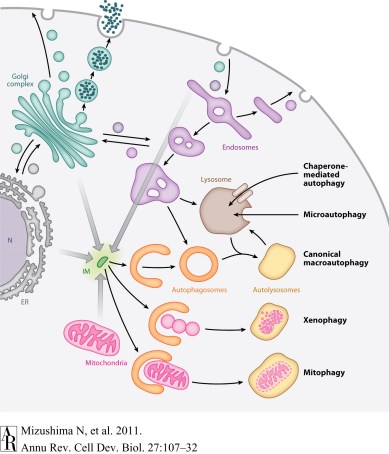
Congratulations to Yoshinori Ohsumi, of the Tokyo Institute of Technology, who won the 2016 Nobel Prize in Physiology or Medicine for his work on autophagy, the process by which a cell “recycles its content,” and his identification of genes responsible for this process.

cellbio270107-f1Dr. Ohsumi’s research has shown how “self-eating” in cells provides them with the energy and components necessary to renew themselves, helping organisms resist starvation, among other types of stress. Autophagy also helps cells to fight infections and prevent the negative consequences of aging.

Parkinson’s, cancer, and type 2 diabetes were later linked to disruptions in autophagy, leading scientists to target this process in order to develop treatments for these diseases.

Learn more.

Read Dr. Ohsumi’s articles on autophagy for the Annual Review of Cell and Developmental Biology and the Annual Review of Biochemistry.

MacArthur Fellows, Class of 2016

Our warmest congratulations to the 23 people honored this year by the MacArthur Foundation for “breaking new ground in areas of public concern, in the arts, and in the sciences, often in unexpected ways.”

Among them is Dianne K. Newman, a Microbiologist at the California Institute of Technology and of the Howard Hughes Medical Institute. She is also an Editorial Committee Member of the Annual Review of Earth and Planetary Sciences.

Dianne Newman
Dianne Newman, 2016 MacArthur Fellow, Caltech, Pasadena, CA, 09.08.2016.

Dr. Newman’s research in microbiology spans across disciplines, from geobiology to biomedicine: she and her group study bacteria that thrive in low-oxygen environments, such as bacteria that “breathe” arsenic or iron, as was the case in Earth’s early atmosphere. This work has taken them to study the metabolism of Pseudonoma aeruginosa, an opportunistic bacterium that thrives in mucus-filled lungs where oxygen is limited, such as those of cystic fibrosis patients. This could open the door to more effective treatment of these infections. Browse the articles she wrote for Annual Reviews here.

Another 2016 MacArthur Fellow is Bioengineer Rebecca Richards-Kortum, of Rice University.

Rebecca Richards-Kortum
Rebecca Richards-Kortum, 2016 MacArthur Fellow, BioScience Research Collaborative at Rice University, Houston, August 31, 2016.

Dr. Richards-Kortum and her students create cheap and effective solutions that seek to redress imbalances in access to health care across the world. Their products have helped overcome challenges in the diagnosis of various types of cancers, but also for the care of premature newborns or babies with jaundice. Read her article for the Annual Review of Physical Chemistry here.

Photo credit: John D. & Catherine T. MacArthur Foundation.

2016 Lasker Awards

Congratulations to the winners of the 2016 Lasker awards.

1. Basic Medical Research Award:

William G. Kaelin, of Dana Farber-Harvard Cancer Center.

Gregg L. Semenza, of Johns Hopkins University.

They helped identify how all animals react to variations in oxygen. They share the award with Peter J. Ratcliffe, of Oxford University. Click on their names to read the articles they wrote for various Annual Reviews journals.

2. Lasker-DeBakey Clinical Medical Research Award:

Charles M. Rice, of Rockefeller University.

He shares the award with Ralf  F. W. Bartenschlager, of the University of Heidelberg, and Michael J. Sofia, of Arbutus Biopharma. Drs. Rice and Bartenschlager were able to find a way to make the Hepatitis C virus replicate in laboratory conditions, which allowed research to proceed. Dr. Sofia then developed a drug that made it possible to treat the disease.  Click on Dr. Rice’s name to browse the articles he wrote for various Annual Reviews journals.

3. Lasker-Koshland Award for Special Achievement in Medical Science:

Bruce M. Alberts, of the University of California, San Francisco.

He was recognized for his work in molecular biology and his efforts toward science education. Click on his name to browse the articles he wrote for the Annual Review of Biochemistry.

2017 NAS Award for Scientific Reviewing – Call for Nominations in Criminology

Annual Reviews is pleased to sponsor the 2017 National Academy of Sciences (NAS) Award for Scientific Reviewing, presented in criminology.

The award was established in 1977 through a gift from Annual Reviews together with the Institute for Scientific Information (ISI) to recognize the importance of reviews to the scientific method. Annual Reviews currently sponsors the award in its entirety.

The NAS Award for Scientific Reviewing recognizes authors whose publications have reviewed important subjects of research, rendering a significant service to science and influencing the course of scientific thought. Since its establishment, the award has been presented to 38 recipients, two who have gone on to win a National Medal of Science in the Biological Sciences and two who proceeded to win a Nobel Prize.

This year’s selection committee defines “reviews” broadly to include not only formal review articles but any publication that synthesizes and critiques existing research, offering useful new perspectives on a field. The award will honor the cumulative effect of the candidate’s writings, which may be embodied in multiple publications. To nominate a review author in the field of Criminology, you must submit your application by Monday, October 3, 2016.

Annual Reviews was founded as a nonprofit organization to synthesize the ever-increasing volume of scientific research and data in a growing number of disciplines. Since the publication of the first Annual Review of Biochemistry in 1932 to our newest journal the Annual Review of Criminology in 2018, Annual Reviews has brought to its readers the best in comprehensive scientific review literature.

The NAS is a private, nonprofit society of distinguished scholars. Established by an Act of Congress, signed by President Abraham Lincoln in 1863, the NAS is charged with providing independent, objective advice to the nation on matters related to science and technology. The NAS is committed to furthering science in America, and its members are active contributors to the international scientific community.

Our Microbial Partners

Congratulations to Ed Yong on his new book, I Contain Multitudes: The Microbes Within Us and a Grander View of Life, in which he explores the microbes that live and multiply all over humans and other animals, helping us thrive and shaping our behavior.

d254a7289eef4af7a42fa211d903ee0a

While our view of microbes is still heavily skewed by the germ theory of disease, which paints them solely as pathogens, recent research has shown that an estimated 50% of the cells we carry around are microbial in nature, and only a fraction of these actually make us ill.

In fact, each animal is an ecosystem and our individual microbiomes play an essential role in keeping us healthy. They help us evolve, break down nutrients from the food we eat so we can better assimilate them, teach our immune system how to defend us from disease, and favor brain development, among other things. Scientists even found that germ-free mice exhibited autism-like behavior, and that probiotic therapies can have positive effects on depression and anxiety.

Yong cited seven of our articles in his book, all of which you can access for free for the next 30 days

The Influence of Milk Oligosaccharides on Microbiota of Infants: Opportunities for FormulasAnnual Review of Food Science and Technology
Biofilms and Marine Invertebrate Larvae: What Bacteria Produce That Larvae Use to Choose Settlement SitesAnnual Review of Marine Science
The Microbiome in Infectious Disease and InflammationAnnual Review of Immunology
Ecological Physiology of Diet and Digestive SystemsAnnual Review of Physiology
Vaginal Microbiome: Rethinking Health and DiseaseAnnual Review of Microbiology
Human Milk Glycans Protect Infants Against Enteric PathogensAnnual Review of Nutrition
The Human Gut Microbiome: Ecology and Recent Evolutionary ChangeAnnual Review of Microbiology

For more, listen to Yong discussing his book with Fresh Air‘s Terry Gross on August 18, 2016.

Leader and Leadership Development

We now know that leaders are mostly made, not born.

As organizations worldwide put a growing emphasis on finding, developing, and keeping leaders, leadership development has drawn from decades of research to become a discrete scholarly field of organizational psychology.

Establishing a framework for this field can help individuals and organizations create and expand their capabilities for effective leadership.

In their article “Leadership Development: An Outcome-Oriented Review Based on Time and Levels of Analyses,” David Day and Lisa Dragoni outline this framework and review the current knowledge to set up a theoretical foundation for future research.

“Leader development” implies a focus on individual leaders to identify short-term indicators that the work will bring about positive long-term outcomes. In this first video, Dr. Day, of the University of Western Australia, tells us more:

Once these indicators are established, Dr. Day goes on to explain that effectiveness of leadership should not be the goal of research and intervention. Instead, the goal should be to expand and enhance a leader’s capacity to be effective:

Beyond the individual, there are things organizations can do to foster leadership. In this video, Dr. Dragoni discusses the conditions that support leadership development. These include interpersonal comfort among team members, their expertise, and a shared mindset:

Lastly, Dr. Dragoni presents new avenues of research for leadership development. She insists that it is important to be very clear about the definition of the terms in order to advance this science.

Read the article in the 2015 Annual Review of Organizational Psychology and Organizational Behavior, with our compliments. 

Congrats Sergio Verdú – winner of the 2016 NAS Award for Scientific Reviewing

Annual Reviews is a non-profit publisher of highly-cited reviews that synthesize the research literature in clear and compelling style to stimulate discussion about the science that shapes our lives.

The National Academy of Sciences (NAS) Award for Scientific Reviewing was established in 1977 through a gift from Annual Reviews together with the Institute for Scientific Information (ISI), now part of Thomson Reuters Intellectual Property & Science, in honor of our founder J. Murray Luck – we are proud to currently sponsor it entirely.

This prestigious award – two recipients have gone on to win the National Medal of Science and another two the Nobel Prize – has been presented annually since 1979 to recognize authors, whose reviews have synthesized extensive and difficult material, rendering a significant service to science and influencing the course of scientific thought. The field rotates among biological, physical, and social sciences.

The NAS dome depicts an early 20th Century view of Science. Photo credit: Dan W Bailey.

We’re delighted that Sergio Verdú, the Eugene Higgins Professor of Electrical Engineering at Princeton University, will receive the NAS Award for Scientific Reviewing on May 1st 2016 at their stunning building in Washington D.C., presented this year in computer science. Our President and Editor-In-Chief, Richard Gallagher (current) and Samuel Gubins (former) will attend the ceremony. 

Sergio won “For consistent and distinguished contributions of review material in information theory, and for a leading role in developing high-quality review journals covering broad areas of the information sciences”. He is a leader in information theory, has contributed numerous books, monographs, book chapters, and review papers, many of which have become essential reading for those working in information and communication theory.

This award serves to highlight the value that review articles add to the research community. Reading one is like being transported into the laboratory of the leading scientists in the area, who explain what’s going on in the field. Readers come away with a richer understanding than they could gain in any other way and this is why Annual Reviews is a treasured resource.

Note: The 2017 NAS Award for Scientific Reviewing will be for contributions in the field of Criminology. Nominations must be submitted online no later than 11:59 pm EDT on Monday, October 3, 2016, so register today and share your pick.